We offer best solution for filtration

(+86)19551271973
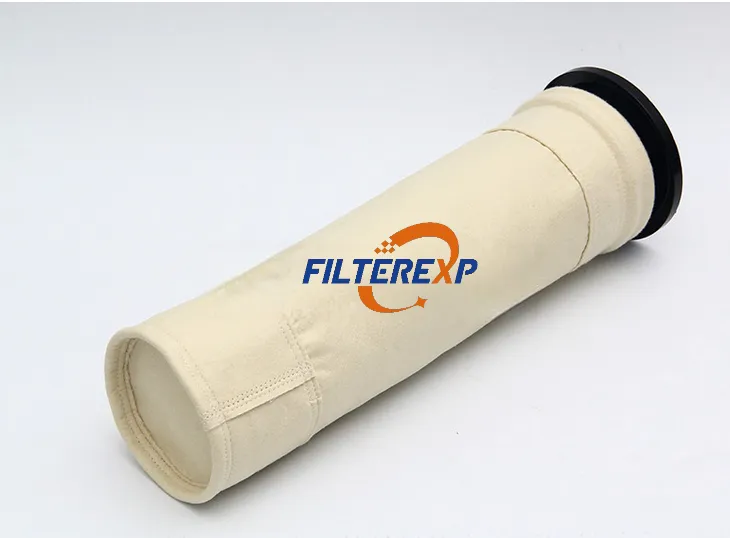
Filterexp specializes in manufacturing high‑performance dust filter bags designed for industrial dust removal and flue gas emission management. We offer complete, application‑oriented filtration solutions across multiple industries. Our filter bags guarantee reliable long‑term operation, prolonged service cycles and strict adherence to environmental protection requirements.
Additional Processing
Heat Setting
Singeing
PTFE Membrane Lamination
Water
Oil Repellent Treatment
Anti-static Treatment
Sewing & Structural Processing
-Material: Polyester (PET), PPS, P84, Acrylic, Fiberglass, Aramid, Polypropylene (PP).
-Thickness: 1.2 – 2.5 mm.
-Weight: 450 – 650 g/m².
-Width: 1.5 – 2.2 m (customizable).
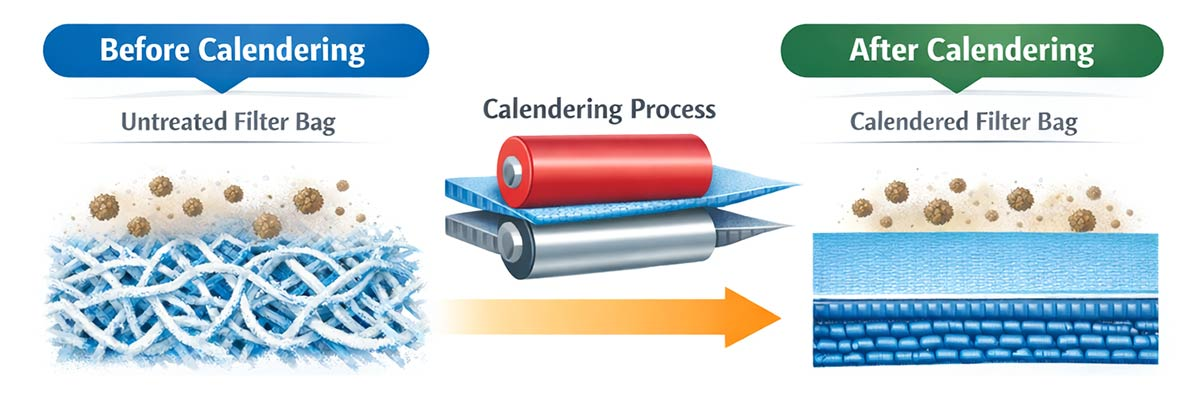
Calendering, also referred to as glazing, is an essential finishing process for filter fabrics of dust filter bags. During calendering, filter media runs through a group of precision polished metal rollers under precisely controlled temperature and pressure.
Usually carried out after singeing to eliminate loose surface fibers and prior to heat setting, this process compresses surface fibers of the fabric to achieve a smooth, compact and even surface finish. Temperature and pressure are fine tuned based on filter media types, delivering ideal surface treatment while preserving the fabric’s native filtration performance.
What are the benefits of calendering for dust collecting filter bags?
Calendering delivers significant performance improvements for dust filter bags, boosting filtration efficiency, service life and overall operational stability.
Superior dust release for easier cleaning The smooth calendered surface stops dust particles from penetrating deep into fabric fibers. Dust cakes build up on the material surface and peel away readily during pulse jet cleaning. This cuts cleaning cycles and reduces pressure drop across the system.
Higher filtration efficiency By compressing surface fibers and narrowing the fabric’s effective pore size, calendering raises fine particle capture efficiency. It achieves more complete dust separation to satisfy stringent emission requirements.
Longer service life A compact surface layer lowers fiber abrasion from dust friction and mitigates internal fabric clogging. This effectively extends filter bag service cycles and cuts replacement expenses.
Optimized dimensional stability Calendering reduces fabric shrinkage. It preserves the filter bag’s original geometry under high temperature or high humidity working conditions, preventing deformation that would degrade filtration performance.
Consistent surface performance Calendering creates uniform smoothness and density over the full filter bag surface. It eliminates uneven filtration zones and supports steady, dependable filtration output.
What filter materials are suitable for calendering?
Calendering works well with most needle punched felts and woven filter fabrics, particularly synthetic fibers capable of enduring the heat and pressure involved in this finishing process. Typical applicable materials are listed below:
-Polyester (PET) Most commonly used for calendering. Boasts favorable heat resistance and mechanical strength, ideal for general purpose industrial dust filtration.
-Polypropylene (PP) Light weight and corrosion resistant. Well suited for calendering and performs reliably under acidic and alkaline filtration conditions.
-Aramid (Nomex) High temperature resistant. Calendering is feasible with precise temperature regulation, making it a solid choice for high temperature dust filtration such as boiler flue gas treatment.
-PPS (Ryton) Outstanding heat and corrosion resistance. Compatible with calendering and extensively deployed in harsh industrial filtration environments.
-P84 (Polyimide) Delivers high filtration efficiency and temperature tolerance. Calendering further optimizes its surface performance for fine dust capture.
-Acrylic Offers moderate heat resistance. Suitable for calendering and widely adopted for medium temperature dust filtration.
-Fiberglass Calendering is viable under tightly controlled temperature settings to prevent fiber damage. It serves high temperature filtration cases where alternative materials fail.
Note Calendering parameters including temperature, pressure and roller speed shall be customized for each filter material, to achieve optimal finishing results while preserving the material’s native performance.
| Material | Working Temperature | Instant Temperature | Abrasion Resistance | Hydrolysis Resistance | Acid Resistance | Alkali Resistance | Oxidation Resistance |
| Polyprolene Needle Felt | 90℃ | 110℃ | Good | Excellent | Excellent | Excellent | Middle |
| Acrylic Needle Felt | 120℃ | 130℃ | Middle | Good | Good | Middle | Good |
| Polyester Needle Felt | 130℃ | 150℃ | Excellent | Poor | Middle | Fair | Good |
| PPS Needle Felt | 180℃ | 200℃ | Good | Excellent | Excellent | Excellent | Fair |
| Aramid Needle Felt | 204℃ | 220℃ | Good | Middle | Middle | Good | Middle |
| P84 Needle Felt | 240℃ | 260℃ | Good | Middle | Middle | Middle | Good |
| Fiberglass Needle Felt | 250℃ | 280℃ | Fair | Good | Middle | Fair | Good |
| Comparison Item | Calendering | PTFE Membrane |
| Cost | Low | High |
| Filtration Mechanism | Surface densification | Microporous membrane filtration |
| Filtration Precision | Moderate improvement | High precision |
| Suitable Applications | Standard operating conditions | Ultra-low emission requirements |